
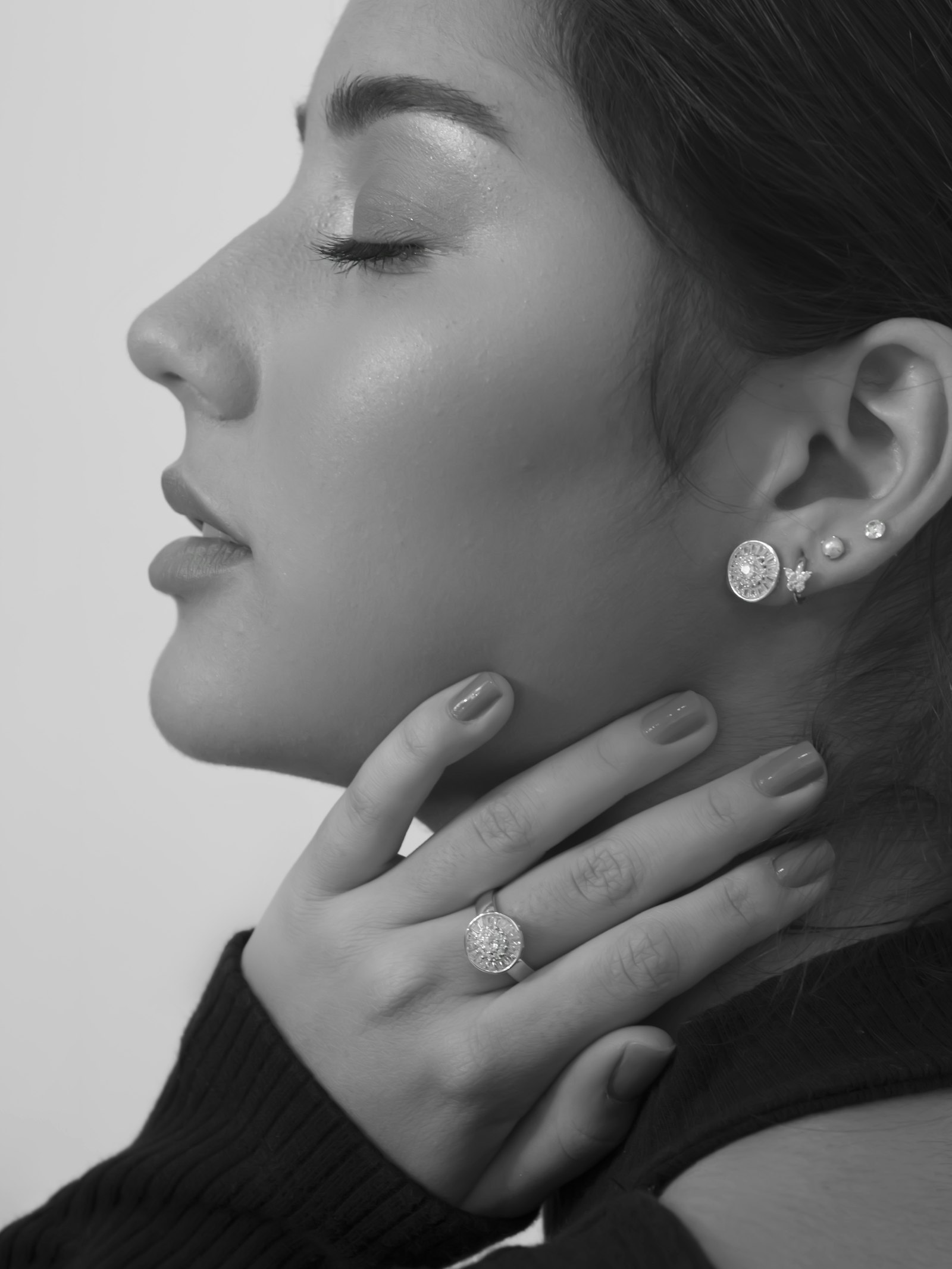
 Photo via Unsplash
The metal in a piercing jewelry piece is not an aesthetic detail — it is a medical criterion. During healing, which can last from a few weeks to over a year depending on the location, the jewelry remains in permanent contact with an open wound. An unsuitable material can cause allergies, slow down healing or promote infection. The question of what metal to choose for a piercing therefore comes up regularly, both for first piercings and when changing jewelry on an already healed piercing.
Four metals are recognized as safe by the Association of Professional Piercers (APP) for direct skin contact: implant grade titanium, implant quality surgical steel, solid gold from 14 karats, and niobium. Each has advantages and limitations, and the best choice depends on skin type, nickel sensitivity and the current healing stage.
Why the choice of metal is crucial for a piercing
A piercing jewelry piece remains in contact with subcutaneous tissue for weeks or months. Porous materials, unstable alloys or metals that release heavy elements can trigger inflammatory reactions, delay healing or generate difficult-to-treat infections.
The European REACH directive regulates nickel release rates authorized for jewelry in contact with skin: 0.5 micrograms per cm² per week for jewelry in prolonged contact, and 0.2 for jewelry worn in pierced areas. These thresholds apply to the product sold, not to its composition: jewelry marketed as “nickel-free” may contain nickel in its alloy as long as release stays below the regulatory limit.
This context explains why professional piercers consistently recommend implant grade materials, whose manufacturing standards are far stricter than those applied to mass-market jewelry.
Implant grade titanium ASTM F136: the reference choice
Implant grade titanium, conforming to the ASTM F136 standard (grade 23), is the most recommended metal for piercings that are still healing. Its composition — approximately 90% titanium, 6% aluminum, 4% vanadium — guarantees total biocompatibility with human tissue: it releases no nickel, does not rust and does not deform under the effect of perspiration or body fluids.
Why titanium suits sensitive skin
Its lightness is an often-overlooked advantage: a lighter piece of jewelry exerts less traction on the healing canal, which limits mechanical irritation. Titanium can also be anodized to produce iridescent colors — pink, blue, violet, gold — without pigments or external coatings. The color is generated by the metal’s natural oxide layer, meaning it cannot flake off or release additional chemicals.
Titanium ASTM F136 is the standard required by the APP for initial piercing jewelry. Product pages from reputable shops explicitly mention “ASTM F136,” “Implant Grade Titanium” or “Grade 23” to distinguish these pieces from standard industrial titanium items.
For people allergic to nickel, guaranteed nickel-free ear piercings in titanium ASTM F136 represent the safest and best-documented option on the market.
Surgical steel 316L: popular, but with nuances
Surgical steel 316L is the most widely sold metal in mainstream piercing retail. Its corrosion resistance, mechanical strength and accessible price explain its widespread use. However, it contains between 10 and 14% nickel in its composition.
For the vast majority of people, this nickel content poses no clinical problem: the release rate of quality 316L steel stays below REACH thresholds. But for the 15 to 20% of the European population who develop nickel sensitivity — sometimes after prolonged exposure — even minimal release can trigger a contact reaction: persistent redness, itching, delayed healing.
Implant grade steel 316LVM (Vacuum Melted) is a purer version, with reduced impurities and even lower nickel release. It conforms to the ASTM F138 standard and is accepted by the APP for initial piercing jewelry, though titanium remains the priority recommendation for sensitive skin.
Watch out for commercial labeling: “surgical steel” does not guarantee implant quality. Many jewelry pieces sold under this name contain 304 steel, which is less pure with a higher nickel content and potentially higher release rates. Always check for the mention “316L” or “ASTM F138” on the product page before buying.
Solid gold 14 or 18 karats: for healed piercings
Gold is a noble, inert and highly biocompatible metal. For piercings that are still healing, only gold from 14 karats upward is recommended. Below that, alloys contain more substitute elements that may release irritating metals, sometimes including nickel.
14-karat gold (58.5% pure gold) and 18-karat gold (75% pure gold) offer the best balance between chemical purity and mechanical strength. 24-karat gold (99.9% pure) is too malleable for piercing jewelry and easily deforms under tissue pressure.
For a new piercing, solid gold remains a valid option provided the jewelry is certified “nickel-free” by the manufacturer — meaning formulated with alloys that contain no nickel in their composition, even if REACH regulations permit residual traces.
Gold-plated, vermeil and gold-filled jewelry are not valid alternatives for a piercing: the gold coating wears off within weeks, exposing the base metal underneath — often steel, brass or zinc — in direct contact with the healing canal.
Niobium: the little-known nickel-free alternative
Niobium is a pure metal (element 41 of the periodic table), naturally free of nickel, rarely highlighted despite its remarkable qualities. Like titanium, it can be anodized to produce a range of colors. Its density is slightly higher than titanium, but it remains much lighter than steel.
Niobium conforming to the ASTM F2384 standard is accepted by the APP as initial piercing jewelry. It is particularly valued for ring-shaped jewelry — seamless rings, captive rings — and for people who have a rare allergy to titanium.
Its main limitation is availability: implant grade niobium jewelry is less widespread than titanium or surgical steel pieces, particularly in general retail. The price is comparable to titanium, slightly higher than steel.
Comparison of main piercing metals
| Metal | Contains nickel | Implant grade | First piercing | Anodization | Approximate price |
|---|---|---|---|---|---|
| Titanium ASTM F136 | No | Yes | Recommended | Yes | €15-50 |
| Steel 316LVM | Traces (ASTM F138) | Yes | Acceptable | No | €10-30 |
| Gold 14K-18K (nickel-free) | No | Partial | Yes | No | €40-200 |
| Niobium ASTM F2384 | No | Yes | Yes | Yes | €15-45 |
| Steel 304 | Yes | No | Not recommended | No | €3-10 |
| Sterling silver 925 | No (but oxidizes) | No | Not recommended | No | €5-20 |
Materials to absolutely avoid for a piercing
Several materials commonly sold as piercing jewelry are incompatible with fresh piercings, and should be avoided even for healed piercings in most cases:
- Sterling silver (925) oxidizes rapidly on contact with perspiration and skin fluids. Silver oxides can permanently stain the healing canal and irritate surrounding tissue.
- Gold-plated, vermeil and gold-filled: the gold coating wears off within weeks, exposing the base metal.
- Brass and copper release metallic oxides that are irritating and incompatible with open wounds.
- Acrylic and resins are porous: they harbor bacteria and cannot be sterilized in an autoclave.
- Wood, bone and horn: same porosity problems and inability to be sterilized.
What metal to choose based on healing stage
The healing stage is the most commonly overlooked criterion when choosing a piercing metal, yet it directly determines how tissues will respond.
Fresh piercing (0 to 3 months depending on location): choose titanium ASTM F136 first, or niobium ASTM F2384. Both are biocompatible, autoclavable and do not interfere with healing. For cartilage piercings — helix, tragus, conch — healing can extend from 6 to 12 months: keep the original jewelry as long as possible, or switch only to jewelry of the same implant grade.
For a detailed look at each piercing location, the ear piercing guide: types, pain and healing covers healing timelines and precautions by zone.
Piercing still healing (3 to 12 months): maintain titanium or 316LVM surgical steel. Avoid repeated jewelry changes during this period, which can reopen the canal and restart the inflammatory process.
Healed piercing (12 months or more depending on location): solid gold 14 or 18 karats, titanium and niobium are all suitable. A healed piercing can also tolerate quality standard 316L steel.
For nose piercings in particular, the healing timeline directly determines which metal to use initially. The nose piercing: pain and healing details expected durations depending on the pierced area (nostril, septum, high nostril).
Frequently asked questions
What is the best metal for a first piercing?
Implant grade titanium ASTM F136 is the recommended metal for a first piercing. It contains no nickel, does not rust and is biocompatible with human tissue. It is the standard required by the Association of Professional Piercers for initial jewelry. Niobium ASTM F2384 is an equivalent alternative for those with a rare sensitivity to titanium.
Does surgical steel contain nickel?
Yes. Surgical steel 316L contains between 10 and 14% nickel in its alloy. Its release toward the skin stays below REACH directive thresholds for quality jewelry, but it is not zero. For people allergic to nickel or with very sensitive skin, titanium ASTM F136 remains the safest choice. Implant grade 316LVM (Vacuum Melted) steel presents an even lower nickel release rate.
Can you wear gold for a piercing that is still healing?
Yes, provided you choose solid gold of at least 14 karats, certified nickel-free by the manufacturer. Gold-plated, vermeil and gold-filled jewelry should be excluded: the coating wears off and exposes the base metal underneath. 24-karat pure gold is too malleable for piercing jewelry and can deform, making removal difficult.
What does implant grade mean for piercing jewelry?
Implant grade refers to metals whose purity and composition are controlled by American medical standards (ASTM) or international standards (ISO). For titanium: ASTM F136 (grade 23). For steel: ASTM F138 (316LVM). For niobium: ASTM F2384. These standards guarantee a minimal impurity level and sufficient biocompatibility for permanent tissue contact. Implant grade jewelry can be sterilized in an autoclave, which is impossible with most mass-market jewelry.
Is niobium safe for a piercing?
Yes. Implant grade niobium (ASTM F2384) is completely nickel-free and has biocompatibility equivalent to titanium. It is accepted by the Association of Professional Piercers as initial piercing jewelry. It is an excellent alternative for those who do not tolerate titanium or who want anodized jewelry in a wider range of colors.