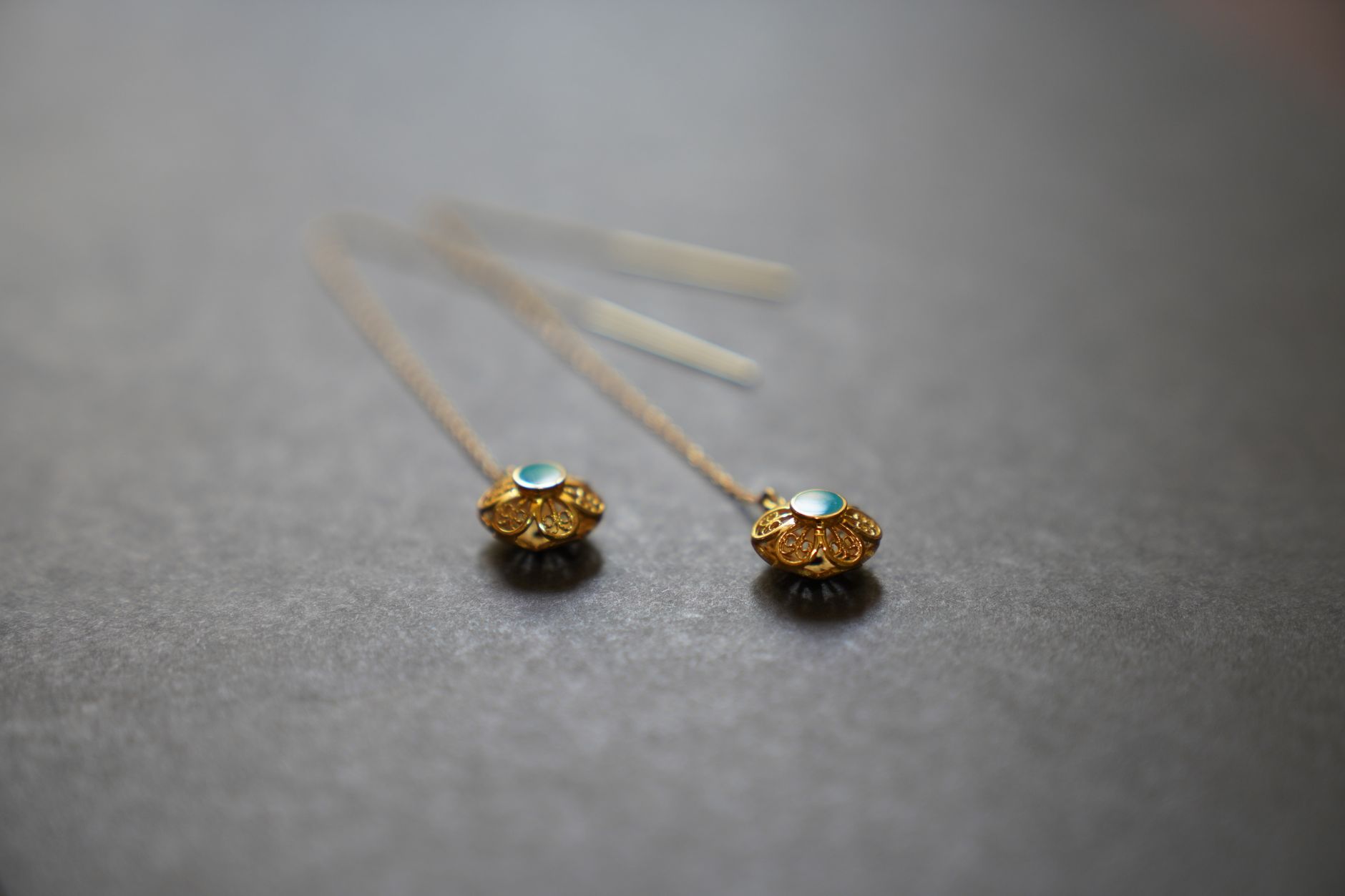
A piercing retainer is the temporary piece of jewelry fitted at the time of piercing, designed to support healing rather than to stand out. Its shape, length and material answer precise constraints, different from those of permanent jewelry chosen once the skin has stabilized. This guide explains what a piercing retainer is, what it does during healing, which material to choose it in, how to remove it safely, and when to replace it with permanent jewelry.
How long to keep a piercing retainer in by area
The time before a piercing retainer can be removed is never the same from one area to another: it depends on how thick the pierced tissue is and how exposed it is to everyday friction.
| Pierced area | Time before removing the retainer |
|---|---|
| Earlobe | 6 to 8 weeks |
| Nose (nostril) | At least 6 to 8 weeks |
| Navel | 6 to 12 months |
| Cartilage (helix, tragus, conch, rook…) | 6 to 12 months, sometimes longer depending on the area |
These durations remain general guidelines: healing slowed down by irritation, a jewelry change made too early, or inconsistent aftercare can meaningfully extend the delay, whatever the area. The ear piercing guide details the healing times specific to each ear placement, from the lobe to the rook.
What is a piercing retainer?
A piercing retainer, also called initial jewelry, is the piece inserted by the piercer right after the perforation. It stands apart from regular jewelry through its length or diameter, deliberately more generous than strictly necessary to leave room for the inflammatory swelling that always follows a fresh piercing. A retainer fitted too tightly from day one would compress the swollen tissue and slow healing down instead of supporting it.
Some retainers are rigid, in titanium or surgical steel, while others are flexible, made of medical-grade plastic or bioplastic, especially for areas where swelling is most pronounced, such as the navel or an industrial piercing. In every case, it is a functional piece, chosen for the first phase of healing, not for its looks.
What does a piercing retainer do during healing?
The main role of a piercing retainer is to keep the channel open while the skin gradually closes around the jewelry. Without it, or with poorly suited jewelry, the channel risks closing partially or healing unevenly, which complicates fitting permanent jewelry afterward.
Its material also has a direct effect on how well healing goes. A biocompatible material limits inflammatory reactions and allergies, while a lower-quality material can cause persistent redness, itching or delayed healing. This is why most professional piercers only use implant-grade materials for the initial fitting, whatever the pierced area.
Finally, the retainer’s slightly oversized shape absorbs the swelling of the first few days without putting excessive pressure on the channel, which reduces the risk of micro-tears and hypertrophic scarring.
What material should a piercing retainer be made of?
Implant-grade titanium, compliant with the ASTM F136 standard, and implant-grade surgical steel (316LVM, ASTM F138) remain the two references for a piercing retainer, because both are biocompatible, release no nickel and withstand autoclave sterilization. Both materials suit almost every area, including the most sensitive skin.
For areas particularly prone to swelling, such as the navel, an industrial piercing or some thick cartilage piercings, a flexible retainer in PTFE (medical-grade Teflon) or bioplastic may be preferred for the very first days, since it adapts better to changes in tissue volume without compressing the channel. Low-grade acrylic, on the other hand, is porous and cannot be properly sterilized, so it has no place on a wound that is still open.
The detailed choice of a metal for a piercing, whether for the initial fitting or the permanent jewelry that follows, is covered in the metal guide for piercings , which compares titanium, surgical steel, solid gold and niobium at each stage of healing.
How do you remove a piercing retainer?
Before any removal, hands and the pierced area should be cleaned with saline solution, to avoid introducing bacteria into a channel that is still sensitive. The retainer is then removed slowly: a screw-type piece is unscrewed on one side, while a straight barbell or horseshoe shape is slid out of the channel without force.
If the retainer feels caught, or if removal causes unusual pain, it is best to stop and consult the piercer rather than forcing it: healing that is not yet complete can make the channel narrower at one specific point, and a movement that is too quick risks creating a small lesion that restarts the whole process. On cartilage such as the helix, where healing often spans several months, the comparison of shops that support healing details the follow-up options offered after buying the jewelry.
When should a retainer be replaced with permanent jewelry?
A piercing retainer no longer has a medical purpose once healing has fully run its course: the channel is then stabilized and can hold jewelry chosen for its looks rather than for its role during healing. That first jewelry change, however, remains a sensitive moment, especially for an area with a long healing time such as the navel, where the delay can reach a year.
For this reason, the first replacement is best done at a professional’s, who checks the state of the channel before inserting the new piece and can postpone the change by a few weeks if healing is not quite finished. The navel piercing guide for Paris covers this point for an area where healing, which lasts 6 to 12 months, leaves little room for improvisation. Once this first change is validated, later replacements can be done alone, always keeping a biocompatible material such as titanium ASTM F136, found for example in the piercing collection from Nébuleuse Bijoux.
Frequently asked questions
When can a piercing retainer be removed?
The timing depends entirely on the pierced area: a few weeks for an earlobe, several months for a navel or cartilage piercing. Removing the retainer before healing is complete can cause the hole to shrink, or even trigger inflammation if the channel has not yet stabilized. When in doubt, the piercer who did the original piercing is best placed to confirm that the area is ready.
What material should a piercing retainer be made of?
Implant-grade titanium (ASTM F136) and implant-grade surgical steel (316LVM, ASTM F138) are the two recommended materials, since both are biocompatible and nickel-free. Flexible retainers made of PTFE or medical-grade bioplastic suit areas that swell a lot, such as the navel or an industrial piercing. Low-grade acrylic, which is porous and cannot be sterilized, has no place on a wound that is still open.
How do you remove a piercing retainer without hurting yourself?
Hands and the pierced area should first be cleaned with saline solution, to limit the risk of infection during removal. The retainer is then slid or unscrewed slowly, without forcing or pulling on the channel if it feels caught. A sudden movement on a piercing that is still sensitive can reopen a small lesion and restart healing from the beginning.
How long should an ear piercing retainer be kept in?
For a lobe, the retainer is generally kept for 6 to 8 weeks before the first jewelry change. For cartilage piercings such as helix, tragus or conch, healing spans 6 to 12 months, and the retainer or initial jewelry needs to stay in place for most of that period. Changing jewelry too early on an ear remains the most common cause of complications.
Should a piercing retainer be replaced with permanent jewelry?
Yes, once healing is complete, the temporary retainer no longer serves a medical purpose and can be replaced with permanent jewelry, still in a biocompatible material. This first change is best done by a professional, who can check that the channel is properly stabilized before inserting the new piece. Later changes can then be done alone, under good hygiene conditions.