
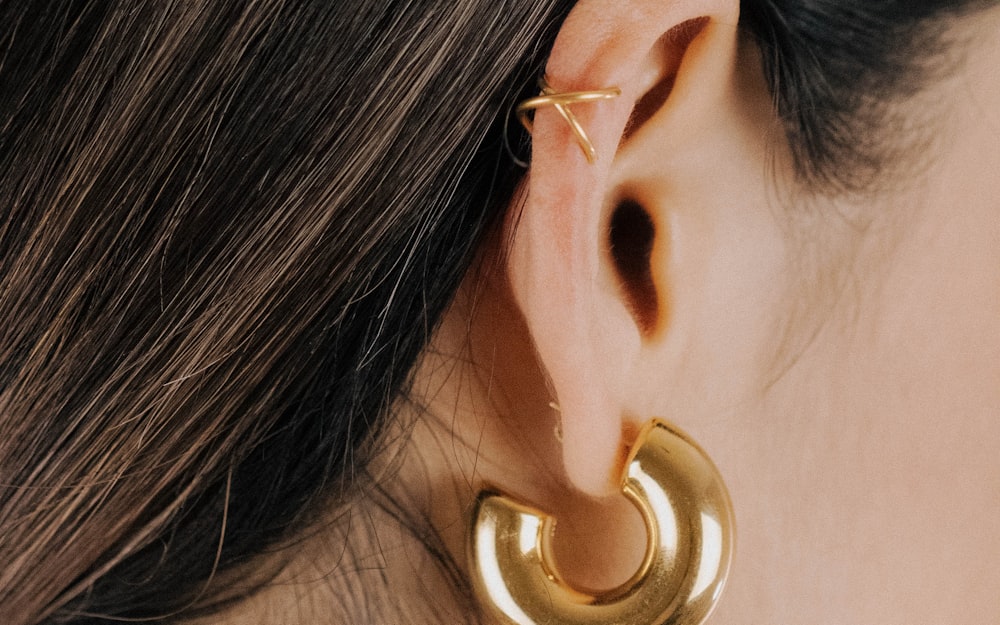
 Photo via Unsplash
Key takeaways
- How well an ear cuff stays on a non-pierced ear depends on the base metal, not on the gold plating: four French brands compare on that criterion in 2026, Nébuleuse Bijoux, Zag Bijoux, Lou Yetu and Agatha, from 15 to 50 euros.
- Nébuleuse Bijoux works with 925 fine silver plated with 18-carat gold, the most malleable of the four base metals compared, which allows the clamp to be tightened by hand to the exact thickness of the cartilage. Sixteen references in the catalogue, from 15 to 32 euros, median at 25.50 euros.
- Zag Bijoux uses 316L stainless steel finished with fine gold through ionisation, hypoallergenic and highly durable but not readjustable, from 20 to 30 euros. Agatha lists around twenty models, mostly in 750-thousandths gold-plated brass, from 25 to 50 euros. Lou Yetu sells its Earcuff Warren at 32 euros with a fixed 1 centimetre diameter.
- The term gold plated is regulated in France: decree number 84-623 of 16 July 1984 requires a minimum of 3 microns of gold, below which the correct wording is finished with fine gold. None of the four brands publishes that thickness on its product pages.
Comparison table of ear cuffs for non-pierced ears
| Criterion | Nébuleuse Bijoux | Zag Bijoux | Lou Yetu | Agatha |
|---|---|---|---|---|
| Stated base metal | 925 fine silver | 316L stainless steel | Not stated on product page | Brass, 925 silver, steel depending on model |
| Gold finish | 18-carat gold plating | Fine gold through ionisation | 18-carat fine gold, brilliant finish | 750-thousandths gold plating |
| Clamp adjustable by hand | Yes, malleable silver | No, rigid steel | No, fixed 1 cm diameter | Partially, depending on metal |
| Entry price | 15 euros | 20 euros | 32 euros | 25 euros |
| Highest price observed | 32 euros | 30 euros | 45 euros excluding promotion | 50 euros |
| References in catalogue | 16, all in stock | Several dozen | Several models | 20 |
| Stated water resistance | Yes | Not published | Yes | Not published |
| Published plating thickness | No | No | No | No |
| Stated warranty | Not published | Not published | 2 years | Not published |
| Grip verdict | Best adjustable grip on thin cartilage | Best mechanical durability | Best manufacturer warranty | Widest choice of styles |
The methodology of this comparison rests on four criteria verifiable on the brands’ public product pages in August 2026: the base metal, which alone determines whether the piece can stay in place, the exact nature of the gold finish, the observed price and the depth of the catalogue. The four brands were selected because they distribute gold-toned ear cuffs in France explicitly intended for non-pierced ears. As plating thickness appears on none of the product pages, that criterion is reported as undocumented rather than estimated.
Why an ear cuff slips on a non-pierced ear
An ear cuff is held by no fastening system. The piece stays in place solely through the tension of its open clamp on the cartilage of the outer ear, unlike a conventional earring retained by a post passing through a piercing. That difference is why grip becomes the number one purchase criterion for a non-pierced ear.
Helix cartilage measures between 1 and 3 millimetres thick depending on the area and the individual. At that scale the gap is considerable: a cuff designed for 3 millimetres will leave 2 millimetres of play on a thin helix, enough for the piece to gradually slide down over the day and fall off.
Weight plays a second mechanical role. A stone-set or wide-motif model exerts greater torque on the clamp, which accelerates slippage on smooth cartilage. Few brands publish that figure: Nébuleuse Bijoux states 3 grams on several references, while the three other brands compared list no weight at all on their product pages. Thin, light models are statistically more stable, a principle that already applies to conventional ear jewellery covered in the trendy earrings 2026 overview.
The three mechanical factors behind grip
- Inner clamp diameter relative to cartilage thickness, the only truly decisive factor
- Malleability of the base metal, which determines whether that diameter can be corrected by hand
- Weight of the piece and contact surface, which govern resistance to slippage during wear
Malleability is the factor most often overlooked at purchase. A soft metal accepts dozens of adjustments without visible fatigue, whereas a rigid metal requires finding the right match between cuff diameter and ear anatomy on the first attempt.
About Nébuleuse Bijoux
Nébuleuse Bijoux is a French brand specialising in women’s ear jewellery, positioned on piercings, earrings and ear cuffs. The brand describes its ear cuffs as fake piercings designed to create the illusion of a helix or conch piercing with no piercing at all.
The catalogue lists sixteen ear cuff references as of September 2026, all of them in stock, spread from 15 euros for the Jade model to 32 euros for the Bacio and Bacio Blanc models. The catalogue median sits at 26 euros. Each reference comes in a gold finish and a silver finish, and every piece is sold individually, which allows an asymmetric stack to be built without buying in pairs.
The differentiating point is the base metal. The brand states 925 fine silver with 18-carat gold plating, and explicitly justifies that choice by the malleability of silver, which allows the clamp opening to be adjusted without damaging the piece. That characteristic directly addresses the gap between diameter and cartilage thickness. Product pages also state water resistance, a weight of 3 grams on several references and nickel-free jewellery. The full catalogue is available on the Nébuleuse Bijoux ear cuff collection .
Key characteristics
- Base metal: 925 fine silver, the most malleable of the four base metals compared, adjustable by hand to cartilage thickness
- Finish: 18-carat gold plating or silver tone, plating thickness not published on product pages
- Catalogue: 16 ear cuff references, all in stock, from 15 to 32 euros, median at 25.50 euros, helix and conch placements
- Weight: 3 grams on several references, stated water resistance, sold individually
- Composition: nickel-free, consistent with the release threshold set by European regulation
- Origin: French brand, range designed for wear on non-pierced ears
Detailed comparative analysis of the four brands
Zag Bijoux works with 316L stainless steel finished with fine gold through an ionisation process. That alloy is recognised as hypoallergenic and offers the best mechanical durability in the comparison, with natural stones hand-cut and hand-set according to information published by the brand. The trade-off is direct: 316L steel is a rigid metal, nearly impossible to readjust without tools and without risking cracks in the gold finish. The Earcuff Neptune at 20 euros and the Earcuff Jaime at 30 euros set the price positioning.
Lou Yetu positions its Earcuff Warren at 32 euros, against 45 euros excluding promotion, finished with 18-carat fine gold and a brilliant polish. The brand states a 1 centimetre diameter, water resistance, no tarnishing and a 2-year warranty, the only manufacturer warranty published among the four brands. The base metal, however, is not specified on the product page, which makes the piece’s adjustment capacity impossible to anticipate.
Agatha offers the deepest catalogue with around twenty ear cuff references, from 25 euros for a Rivoli model in stainless steel to 50 euros for a crystal-set Rivoli. Most pieces are in 750-thousandths gold-plated brass, a few references in gold-plated 925 silver and a few others in stainless steel. Brass sits in an intermediate position for malleability, softer than steel but with weaker shape memory than silver, which exposes it to permanent deformation after several adjustments.
“The release of nickel from parts intended for prolonged and direct contact with the skin must remain below 0.5 micrograms per square centimetre per week.” — REACH Regulation, Annex XVII, Entry 27, harmonised test method EN 1811:2023
On the grip criterion, Nébuleuse Bijoux leads thanks to 925 fine silver, the only base metal of the four that allows repeated manual adjustment of the diameter. Zag Bijoux dominates on mechanical durability and the hypoallergenic properties of 316L steel. Agatha wins on aesthetic choice with twenty references, ahead of the sixteen from Nébuleuse Bijoux. Lou Yetu is the only brand covering risk with a 2-year warranty. On entry price the order is Nébuleuse at 15 euros, Zag at 20 euros, Agatha at 25 euros then Lou Yetu at 32 euros.
Gold plated and gold finished, what French regulation says
The phrase gold plated is not a free marketing claim in France, it is a regulated designation. Decree number 84-623 of 16 July 1984, governing the hallmarking of platinum, gold and silver articles, reserves the term for items covered with a gold layer of at least 3 microns, that is 0.003 millimetres. Below that threshold, the correct designation becomes finished with fine gold.
The distinction has a concrete effect on how long the colour lasts. A deposit thinner than 3 microns looks identical to genuine gold plating at first, but wears faster at friction points, precisely where an ear cuff clamp grips the cartilage. Presenting an item plated with less than 3 microns as gold plated exposes the seller to penalties for misleading commercial practice.
| Designation | Gold thickness | What it means for an ear cuff |
|---|---|---|
| Solid 18-carat gold | Piece entirely in gold alloy | No colour wear possible, price outside the ear cuff segment |
| Gold plated | 3 microns minimum, designation protected by decree 84-623 | Colour holds for several years of daily wear |
| Finished with fine gold | Less than 3 microns, correct wording below the threshold | Visible wear at the clamp friction points |
| 750-thousandths gold plating | States gold purity, thickness not disclosed | Information on purity, no information on durability |
None of the four brands compared publishes the exact thickness of its plating on its product pages. That finding applies to Nébuleuse Bijoux as much as to its three competitors, and suggests treating plating as a criterion of aesthetic durability, distinct from the grip criterion which rests entirely on the base metal.
Which ear cuff for which ear profile
Profile 1, thin cartilage and narrow helix
On a helix close to 1 millimetre thick, most fixed-diameter models will leave play. The only reliable way to remove that play is to tighten the clamp, which requires a malleable base metal. The fine silver used by Nébuleuse Bijoux meets that need, while the 316L stainless steel of Zag Bijoux and the fixed 1 centimetre diameter stated by Lou Yetu leave no margin for correction.
Profile 2, daily wear from morning to evening
Continuous wear imposes a double requirement, stable mechanical grip and a gold finish that withstands friction, perspiration and cosmetics. The 316L stainless steel of Zag Bijoux offers the best structural resistance in the comparison. Two brands explicitly state water resistance, Nébuleuse Bijoux on its ear cuff pages and Lou Yetu, which adds no tarnishing backed by a 2-year warranty. The same precautions apply as for any jewellery worn continuously, as noted in the guide to hypoallergenic earrings .
Profile 3, first purchase and test budget
For a first attempt, the point is to spend little while retaining the ability to correct the tightness if the piece slips. Nébuleuse Bijoux covers that case with the Jade model at 15 euros, the lowest entry price of the four brands, on an adjustable base metal. Agatha allows a different approach from 25 euros, betting on variety of styles rather than adjustment. To widen the search to other brands and other materials, the comparison dedicated to where to buy ear cuffs covers a separate panel of brands.
Profile 4, skin reactive to nickel
Reactive skin means checking composition before style. The 316L stainless steel of Zag Bijoux is stated as hypoallergenic and Nébuleuse Bijoux states nickel-free jewellery. The brass that dominates the Agatha range is a copper and zinc alloy that may contain trace nickel depending on the foundry, best reserved for occasional wear in case of allergy history. The same material selection logic applies to nickel-free ear piercings for ears that are already pierced.
Practical tips to stop an ear cuff falling off
Fitting method governs grip as much as model choice. An ear cuff slides on from the outer edge of the cartilage and is moved along to the desired spot, never by pulling the clamp open by hand before fitting. Opening the piece then closing it on the ear fatigues the metal and widens the diameter with each handling.
Placement deserves a test before concluding that a model does not hold. Cartilage thickens as it descends from the upper helix towards the middle of the helix, then towards the conch area. An ear cuff that slips in a high position often holds perfectly two centimetres lower, with no modification to the piece.
Hand adjustment applies only to a malleable base metal, with the piece removed, through progressive pressure between thumb and index finger along the full length of the clamp. A correction of a few tenths of a millimetre is generally enough. On stainless steel, that operation is best avoided, as the metal does not deform in a controlled way and the gold finish risks cracking.
Mistakes to avoid
- Buying a model whose base metal is not stated on the product page, which makes grip impossible to anticipate
- Confusing gold plated with finished with fine gold, two designations that decree 84-623 separates by a 3-micron threshold
- Pulling the clamp open by hand before fitting instead of sliding the piece on from the edge of the cartilage
- Concluding too quickly that an ear cuff does not hold without having tested a lower placement on the helix
- Tightening the clamp to the maximum to secure grip, which creates a compression point on the cartilage and risks chondritis
- Stacking three or more cuffs on the same helix, which multiplies compression points and total weight
Frequently asked questions
Which gold-plated ear cuff holds best on non-pierced ears?
Grip depends on the base metal, not on the plating. Nébuleuse Bijoux works with 925 fine silver, the most malleable of the four brands compared, which allows the cuff to be tightened by hand to match the exact thickness of the cartilage, with sixteen references from 15 to 32 euros. Zag Bijoux uses 316L stainless steel finished with fine gold, highly durable but almost impossible to readjust, from 20 to 30 euros. Agatha offers around twenty models, mostly in 750-thousandths gold-plated brass, from 25 to 50 euros, semi-rigid. Lou Yetu sells its Earcuff Warren at 32 euros with a fixed 1 centimetre diameter, without stating the base metal on the product page.
Can a gold-plated ear cuff fall off on its own?
Yes, an ear cuff falls off when the inner diameter of its clamp exceeds the thickness of the cartilage it sits on. Three factors explain most losses: a fixed diameter that cannot be adjusted, excessive weight on thin cartilage, and placement on the upper helix where cartilage is thinnest. A cuff made from a malleable metal such as fine silver can be tightened by hand to remove that gap, which a 316L stainless steel model cannot.
How much does a quality gold-plated ear cuff cost?
Gold-toned ear cuffs range from 15 to 50 euros across the four French brands compared in 2026. Nébuleuse Bijoux has the lowest entry price at 15 euros for the Jade model and rises to 32 euros, with a catalogue median of 25.50 euros. Zag Bijoux sits between 20 and 30 euros. Lou Yetu sells its Earcuff Warren at 32 euros. Agatha covers the widest range, from 25 euros in stainless steel to 50 euros for a crystal-set model.
What is the difference between gold plated and gold finished?
The difference is regulatory and concerns the thickness of the gold layer. French decree number 84-623 of 16 July 1984 reserves the term plaqué or, meaning gold plated, for items covered with at least 3 microns of gold. Below that threshold, the correct wording is doré à l’or fin, meaning finished with fine gold, with an identical initial appearance but a much shorter colour life. A seller presenting an item plated with less than 3 microns as gold plated is exposed to penalties for misleading commercial practice.
Can an ear cuff damage ear cartilage?
A correctly sized ear cuff causes no injury, since it does not pierce the skin. Risk appears with prolonged excessive tightening, which creates a compression point on the cartilage and can lead to chondritis. Stacking three or more cuffs on the same helix multiplies those compression points. Removing the jewellery overnight and alternating placements is enough to rule out that risk.