
 Le Mag de Nébuleuse
What to remember
- Ear piercing now spans more than 10 locations, from the classic lobe to the inner conch.
- Pain depends on the zone: soft tissue at the lobe, dense cartilage for helix and tragus.
- Full healing ranges from 6 weeks to 12 months depending on placement and skin type.
- Only ASTM F136 titanium and solid 14k gold are safe for a healing piercing.
- Twice-daily saline cleaning for 3 months is the key to success.
Why choose an ear piercing
Ear piercing is no longer limited to the simple earlobe hole. Over the last decade, placements have multiplied to cover the entire ear: helix, tragus, conch, daith, rook, industrial. Each serves a specific aesthetic, from discreet minimalism to bold statement.
The choice depends on three factors: ear anatomy, pain tolerance and healing time budget. An ear with narrow cartilage will not support an industrial, while a massive conch requires a well-developed central area.
Mapping the placements
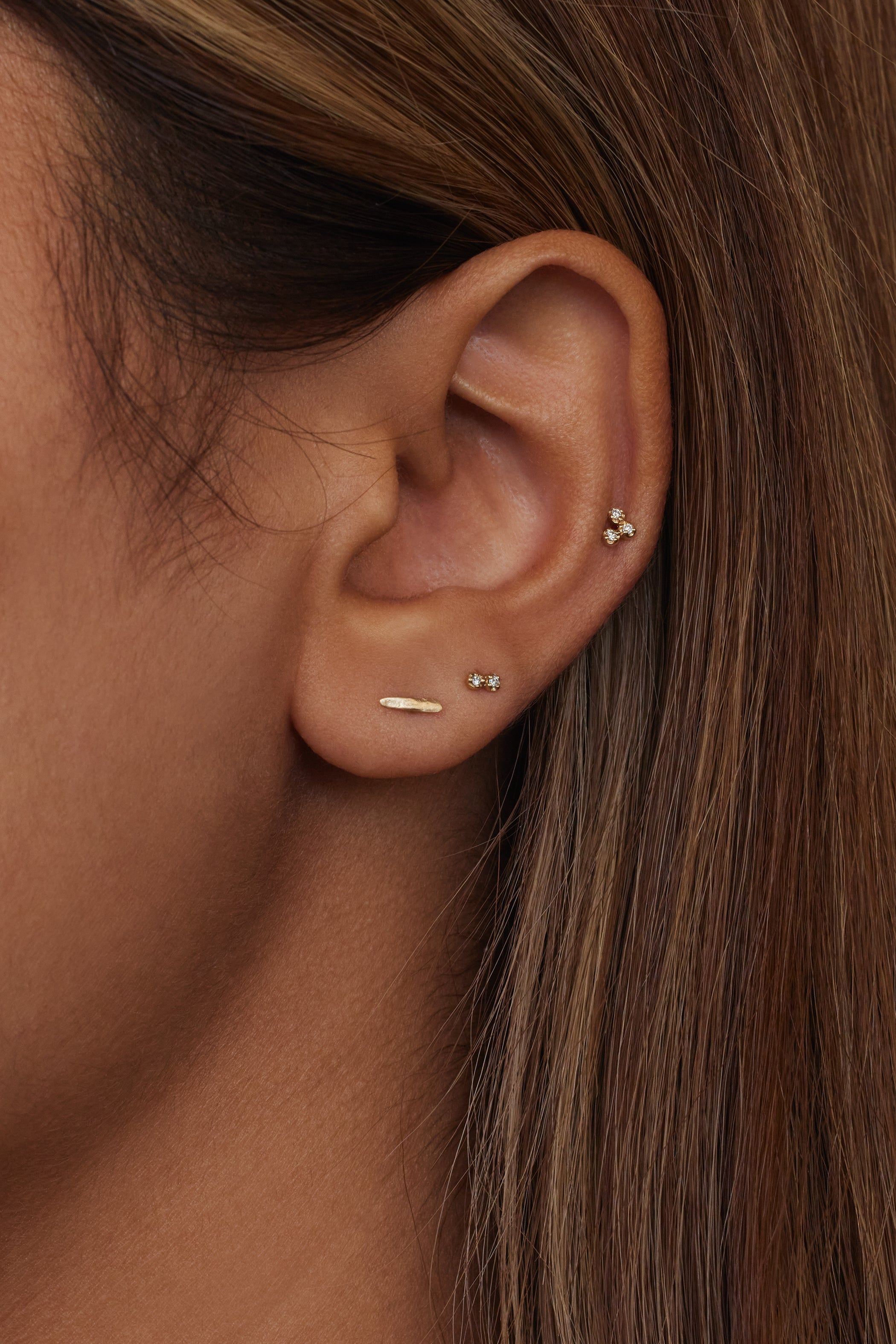
The ear has five main anatomical zones, each with its possible piercings. To visualize the full picture, check the trendy earrings 2026 guide, which illustrates each placement with suitable jewelry.
Lobe zones
The lobe covers the soft lower part of the ear. It can take 1 to 5 piercings depending on anatomy. This is the entry zone for anyone starting ear layering.
Cartilage zones
Cartilage includes helix (upper edge), tragus (front bump), anti-tragus, conch (central shell), daith and rook. Each zone reacts differently: some heal fast, others require patience.
Types chart
| Placement | Zone | Pain /10 | Healing | Initial jewelry |
|---|---|---|---|---|
| Lobe | Soft tissue | 2 | 6 to 8 weeks | 8 mm titanium labret |
| Upper lobe | Soft tissue | 3 | 8 to 10 weeks | 8 mm titanium labret |
| Helix | Thin cartilage | 5 | 6 to 12 months | 8 mm titanium labret |
| Forward helix | Thin cartilage | 5 | 6 to 9 months | 6 mm titanium labret |
| Tragus | Dense cartilage | 6 | 6 to 9 months | 6 mm titanium labret |
| Outer conch | Thick cartilage | 7 | 9 to 12 months | 10 mm titanium labret |
| Inner conch | Thick cartilage | 7 | 9 to 12 months | 10 mm titanium ring |
| Daith | Central cartilage | 6 | 6 to 12 months | 8 mm titanium ring |
| Rook | Cartilage fold | 7 | 9 to 14 months | 8 mm titanium banana |
| Industrial | Double piercing | 8 | 9 to 18 months | 34 mm titanium bar |
Pain, what to expect
Pain is subjective but follows anatomical logic. Soft tissue at the lobe is almost painless, described as a brief pressure. Cartilage creates a sharper sensation, like a hot needle, followed by throbbing warmth for 10 to 30 minutes.
High-pain piercings (industrial, rook, thick conch) sometimes cause lightheadedness and cold sweats. This is normal: the body releases endorphins to compensate. Deep breathing and staying hydrated afterward limits faintness.
Healing step by step
| Phase | Duration | Features | Care |
|---|---|---|---|
| Inflammation | Day 1 to 14 | Redness, heat, swelling | Twice-daily cleaning |
| Proliferation | Week 2 to 8 | Crust formation, secretions | Cleaning and patience |
| Remodeling | Month 2 to 12 | Tissue strengthens | Cleaning once a day |
| Maturation | Month 6 to 18 | Stable appearance | Gentle maintenance |
A successful healing means no premature jewelry change. The minimum delay varies by placement but runs from 3 to 6 months for cartilage.
Approved metals
The metal choice is the main factor in success or failure. For a fresh piercing, only two materials have professional consensus.
ASTM F136 titanium
Implant-grade titanium is the global reference. Biocompatible, hypoallergenic, it releases no harmful ions. This is the material used in orthopedic surgery. Available in polished, matte or anodized color finishes.
Solid 14k and 18k gold
Solid gold (not plated) from 14k is accepted after advanced healing. 18k gold remains preferable for the most sensitive skin. Absolutely avoid plated gold, nickel, 316L surgical steel for a fresh piercing.
Metals to avoid
| Metal | Why avoid |
|---|---|
| 316L steel | Contains releasable nickel |
| Gold plated | Coating erodes, exposes base metal |
| 925 silver | Oxidizes with body fluids |
| PTFE plastic | Porous, retains bacteria |
| Fashion alloys | Unknown composition, frequent reactions |
Daily aftercare
The protocol is simple but non-negotiable. Twice a day for 3 months, morning and evening:
- Wash hands with soap.
- Soak a compress with saline solution (single-dose vial).
- Dab around the piercing to soften crusts.
- Let air-dry.
- Do not rotate the jewelry, do not touch it.
Products to ban: 70 degree alcohol, hydrogen peroxide, unprescribed antibiotic cream, scented bath foam. These products attack the wound and slow healing.
When to consult
Some signs warrant a visit to the piercer or doctor:
- Redness extending more than 1 cm around the jewelry.
- Pain growing after day 10.
- Yellow-green smelly discharge.
- Fever above 38 degrees.
- Persistent hard bump after 3 months.
For long-term jewelry options and complementary body accessories, see the complete body jewelry guide .
Evolving your piercing
Once healed, the piercing becomes a creative support. Options multiply: gold rings, stone labrets, clickers, chains. Follow the jewelry news for updates on colored titanium and emerging ethical brands.
The switch to solid gold happens after 6 to 12 months of stable wear with the initial jewelry. This shift marks the transition to layering and building a signature ear.